

Lower back pain is very common. Pain may come from muscles, facet joints, intervertebral discs, nerves, ligaments, or compensatory movement. The vast majority of the time, the painful area is not the original source of dysfunction (the root cause).
Why Is Low Back Pain So Common?
The low back, or lumbar spine, transfers the forces between the upper and lower body. There are complex interactions between stabilizing muscles and the bone structures (spine and pelvis) that are affected by sitting, stress, poor ergonomics, old injuries, pregnancy/postpartum changes, and sedentary lifestyle.
Why It Matters to Address Low Back Pain Early
It is important to understand that pain is not the beginning of the problem. Symptoms usually arise when there has been a dysfunction and compensatory changes happening for some time (sometimes several years). When there is pain, there is also an inflammatory process going on, and chronic inflammation that is left untreated leads to structural changes that may become irreversible. For example, if a subluxation in the spine is left untreated long enough, we start seeing degeneration in the disc and calcium deposition in the vertebrae.
Low back pain is often the body signaling that something is wrong and needs to be addressed. The right solution is to understand why the area is irritated, why the body is compensating, and what needs to change so that your spine and nervous system can restore full function. If we quiet the pain temporarily with over-the-counter painkillers, the cause of the problem will not go away, and in fact may progress and get worse over time through degeneration of the structures involved.
Key Takeaways
Low back pain is not only mechanical; it may involve inflammation, pain sensitivity, fear of movement, and nervous system processing.
Chiropractic adjustments may influence pain through biomechanical, neurologic, proprioceptive, and inflammatory pathways.
A good care plan should combine evaluation, manual care, movement, reassurance, and recurrence prevention.
$119 New Patient Special
Includes Private Consultation with Dr. Martin Henderson, Comprehensive Spinal & Nervous System Evaluation, Posture, Movement & Tonal Assessment & Personalized Care Recommendations
How Our Care Plan Works
1. Get To The Root Cause Of The Problem
We look beyond symptoms to understand how stress, tension, and compensation patterns may be affecting your health. Our goal is not simply symptom relief, but helping your body heal, adapt, and function at a higher level naturally.
2. Customized Plan Based On Your Goals And My Findings
Your care plan is designed around your goals while incorporating findings from your exam and nervous system scans. Together, we create clear milestones, track your progress, and adjust care as your body improves and adapts over time.
3. Take Back Control Of Your Family’s Health
Through holistic chiropractic care, we help families strengthen their nervous systems, improve resilience, and build healthier habits for long-term healing, wellness, vitality, balance, and an improved quality of life through every stage of life.
How We Treat Lower Back Pain at Threefold Chiropractic In San Anselmo, CA
Comprehensive Consultation and Exam
We begin by listening carefully to your story: when the pain started, what makes it better or worse, whether it travels into the leg, prior injuries, work demands, exercise habits, sleep quality, stress levels, and health goals.
Then we move on to a thorough examination that includes: digital posture assessment, range-of-motion testing, orthopedic exams, neurological screening, gait and movement observation, breathing pattern analysis, and spinal joint and pelvic evaluation.

Nervous System Functional Scans
At Threefold Chiropractic, we perform INSiGHT neurological scans. These are three studies:
NeuroPulse: This scan looks at how your nervous system is adapting to stress. It measures the rhythm of your heart, along with subtle changes in skin conductance and temperature, to help us understand whether your body is stuck in stress mode, recovering well, or adapting efficiently.
NeuroThermal: This scan looks at how evenly your nervous system is regulating along the spine. Since your spinal nerves help control blood flow and temperature in the tissues, temperature differences from side to side may show where your nervous system is under stress or not regulating as well as it should.
Surface EMG: This scan measures the electrical activity of the muscles along the spine. In simple terms, it shows how much energy the nervous system is using to hold the body upright and whether certain spinal regions are overactive, underactive, or imbalanced. It helps communicate patterns of muscular tension, compensation, and postural stress.
After your initial appointment, we will go over your Report of Findings that aims to find the root cause of your symptoms that are preventing you from doing the things that you love and functioning at full capacity. You will be given a folder with all your results and a plan to reach your health goals.
Gentle, Specific Chiropractic Adjustments
Our adjustments are always tailored to the patient, and there are multiple ways that we can perform the adjustment to suit body types and comfort.
For low back pain, this may look like a traditional side-posture or drop-table adjustment of the lumbar spine, pelvis, sacrum, SI joint, hips, and even upper spine when clinically relevant. The objective is to reduce interference, restore proper communication, and help the body reorganize to start the healing process.
Customized Movement and Home Care
You will be given a tailored home care exercise plan, and patients who follow it get better results faster than those who don’t. These exercises are important because they support the care you receive by strengthening the body and improving coordination and stability, and they help the spine hold the adjustments longer.
These exercises usually don’t take more than 10–15 minutes to do and should be done daily. Usually for low back pain, these are focused on strengthening the core and addressing any specific dysfunctions found in your particular case.
Lifestyle Habits, Ergonomics, and Recurrence Prevention
We will have a conversation about any lifestyle habits that need to be addressed that may be working against your recovery. These may range from your workstation ergonomics to breathing patterns or other lifestyle stressors. The goal is to work with you to find where small changes can make a big impact.


Common Causes of Low Back Pain in San Anselmo, CA
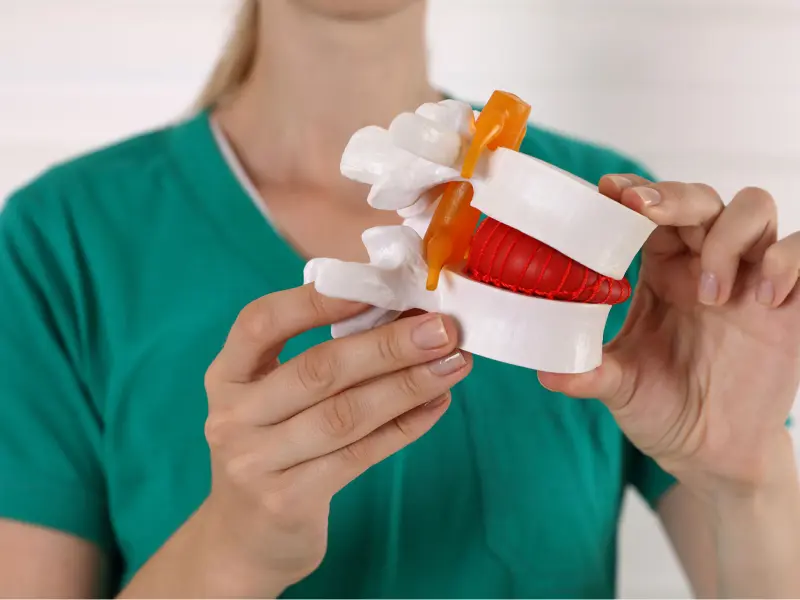
Disc Irritation, Bulge, or Herniation
The intervertebral disc is composed of a nucleus (nucleus pulposus) and a cartilaginous disc surrounding it. The nucleus is made of a jelly-like substance high in proteoglycans, which have a high affinity for water. The cartilaginous disc is made of a fibrous substance. As a unit, they act as vital shock absorbers, stabilize joints, evenly distribute impact, and allow for smooth, frictionless movement. When the normal biomechanics of the spine become affected, as a result of repetitive daily stressors and poor ergonomics, the discs begin to suffer, leading to early degeneration, bulging, and herniation.
A bulge is a broader outward change in the disc, and a herniation is when the nucleus pulposus escapes the cartilaginous disc that contained it, entering the spinal canal. Both a disc bulge and a herniation can be sources of severe pain, and depending on the case, can lead to numbness and weakness due to nerve compression.
Muscle Strain
Many patients say “I threw my back out,” but it is important to understand that muscles can spasm or strain from lifting, twisting, fatigue, repetitive stress, poor conditioning, or compensation. Ultimately, muscles act through nerves. At the neuro-muscular junction, the muscles receive signals to contract or to relax. When that signal is less than optimal (because of a subluxation creating a nerve interference, for example), muscles become weak, tense, guarded, or go into spasm. Recurring “muscle pulls” may mean that the spine, pelvis, hips, or nervous system are not coordinating well, possibly due to a spinal subluxation.
Sacroiliac Joint Dysfunction
The SI joints connect the sacrum to the pelvis. These joints can get irritated and/or “stuck,” and can feel like one-sided low back pain, buttock pain, or pain when standing up from a seated position, walking, or getting out of the car. This area is also very relevant during pregnancy and postpartum due to the significant structural changes happening and the increased production of the relaxin hormone, which increases the laxity of the joints to accommodate the growing fetus. It is also very commonly irritated in desk workers and athletes, but in these cases it is ultimately the result of repetitive daily activities and stressors that are less than optimal (like sitting too much or with poor ergonomics).
Facet Joint Irritation
Facet joints are the pair of small joints in the back of each vertebra. Along with the intervertebral disc, they are the three points that articulate each vertebral segment with the other. They are highly innervated and sensitive, making them a common source of pain when irritated as a result of compression, repetitive loading, or a misalignment on that vertebra. It often feels like localized low back pain that is worse with arching backward, standing, or rotating.
Sciatica / Nerve Irritation
It is important to understand that sciatica is not a diagnosis in itself. It describes pain traveling down the leg along the specific sciatic nerve pathway. It may come from a nerve root irritation in the lumbar spine or from other tissues that irritate the nerve along its pathway down the leg
Degenerative Disc Disease
Degeneration does not always automatically mean pain. Many people have age-related changes on imaging studies without having severe symptoms. Because discs don’t have much blood supply, they need to move to stay hydrated and healthy. Through a process called “imbibition,” they squeeze wastes out and draw nutrients in.
Degeneration in the discs will happen faster in vertebral bodies that are subluxated and not moving normally. Through careful and specific chiropractic adjustments, movement can be improved and normal function reestablished through nervous system regulation.
Poor Posture and Prolonged Sitting
Sitting for too long at a desk performing work duties alters normal breathing mechanics, increases stiffness, and contributes to sensitization and irritation of nerves through facilitation of the sympathetic “fight or flight” response. The psoas muscle is the main hip flexor, and it gets tight when we sit for too long. A chronically tight psoas will pull down on the lumbar spine, potentially damaging the intervertebral discs and facet joints, and irritating nerve roots.
Stress and Nervous System Tension
There have been extensive studies on the detrimental effects of stress on the body. We know that when we are under stress, the sympathetic branch of the autonomic nervous system kicks in (what we call the “fight or flight” mode). When we are stressed, cortisol levels rise, blood pressure and blood sugar rise, along with inflammation.
Modern life is stressful; we are bombarded with information like never before, and it is easy to get “stuck” in this “fight or flight” response mode. It has been said that chronic inflammation is the mother of all diseases. Chiropractic care has been shown to effectively regulate autonomic nervous system tone, which translates into reduced tension, improved sleep, recovery, and overall performance.
Check Out Our Location Near You
11 Belle Ave Suite B, San Anselmo, CA 94960
Frequently Asked Questions About Low Back Pain
When should I be worried about low back pain?
When it follows major trauma, comes with fever, unexplained weight loss, bowel/bladder changes, saddle numbness, or progressive weakness.
Should I rest or keep moving?
In most non-serious cases, gentle movement is better than prolonged bed rest. People are usually encouraged to continue normal activities as part of self-management, as long as the activities don’t make it worse and they are under care for back pain with a chiropractor who is targeting the root cause.
Is low back pain always caused by a disc problem?
No. The WHO notes that about 90% of low back pain is non-specific, meaning it is not clearly explained by one structural diagnosis. It is critical to restore proper function to the biomechanics of the spine.
What is better for low back pain: chiropractic or massage?
They can help in different ways. Massage may reduce soft tissue tension and is very helpful to ease pain in acute cases. Chiropractic care focuses on restoring normal spinal biomechanics, nervous system function, and coordination. Most times, it is irritated nerves that are causing muscles to tense up and feel painful. Every muscle in the body has a nerve that “feeds” and controls it. If the nerve quality is affected, the muscles will either become tense (guarded) or weak.
Why won’t my low back pain go away?
Persistent low back pain may involve many years of joint restriction (subluxation), poor movement patterns, nerve irritation, stress, deconditioning, or repeated daily triggers like aberrant posture. The healing process takes time, usually much less than the breakdown process that resulted in the low back pain. While symptoms may go away in a couple of weeks under proper care, correcting the root cause may take longer.
Resources
Teodorczyk-Injeyan JA, Triano JJ, Gringmuth R, DeGraauw C, Chow A, Injeyan HS. Effects of spinal manipulative therapy on inflammatory mediators in patients with non-specific low back pain: a non-randomized controlled clinical trial. Chiropractic & Manual Therapies. 2021;29:3.
Kirkaldy-Willis WH, Cassidy JD. Spinal manipulation in the treatment of low-back pain. Canadian Family Physician. 1985;31:535–540.
Ellingsen DM, Napadow V, Protsenko E, Mawla I, Kowalski MH, Swensen D, O’Dwyer-Swensen D, Edwards RR, Kettner N, Loggia ML. Brain mechanisms of anticipated painful movements and their modulation by manual therapy in chronic low back pain. The Journal of Pain. 2018;19(11):1352–1365. doi:10.1016/j.jpain.2018.05.012.
$119 New Patient Special
Includes Private Consultation with Dr. Martin Henderson, Comprehensive Spinal & Nervous System Evaluation, Posture, Movement & Tonal Assessment & Personalized Care Recommendations